Shopify Shipping vs Free Shipping Margin Calculator
Should you charge customers for shipping, or offer free shipping and bake the cost into your product price? Enter your numbers to compare margin per order, total profit, and the break-even price uplift — and see which option wins.
Your store
Results (per month)
| A: Charge shipping | B: Free shipping | |
|---|---|---|
| Customer pays per order | ||
| Fees per order | ||
| Margin per order | ||
| Margin % | ||
| Orders | ||
| Total profit |
How the shipping vs free shipping margin is calculated
Option A (charge shipping): customer pays price + shipping charged. Margin per order = (price + shipping charged) − payment fees − COGS − your shipping cost.
Option B (free shipping): customer pays price + uplift. Margin per order = (price + uplift) − payment fees − COGS − your shipping cost. You still pay shipping; it is just hidden in the price.
Total profit = visitors × conversion rate × margin per order. The break-even price uplift is the smallest uplift at which free shipping earns the same total profit as charging shipping, given your free-shipping conversion rate.
Worked example (the defaults)
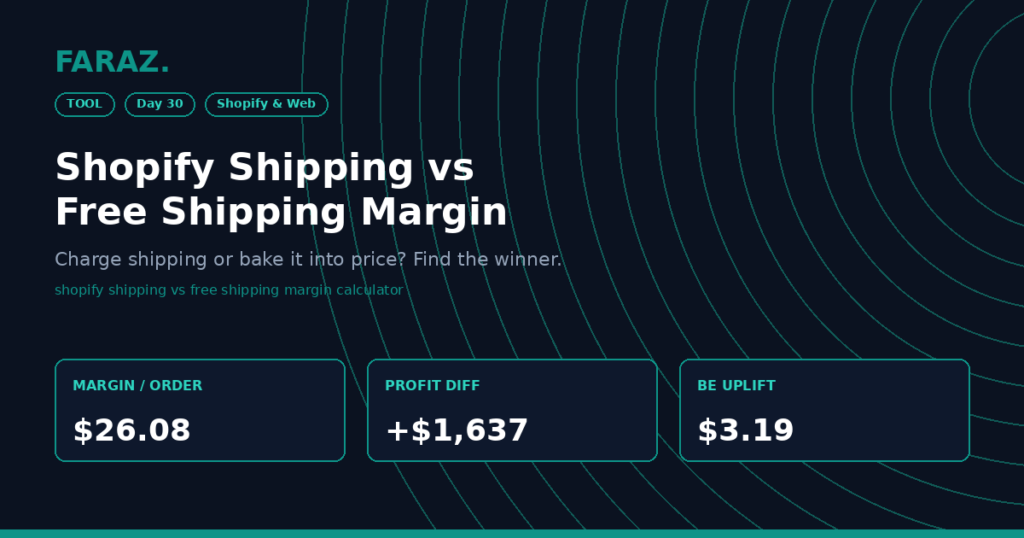
20,000 visitors, $50 product, $20 COGS, $8 shipping cost. Charging $8 shipping at 2.5% conversion gives 500 orders at about $28.02 margin = ~$14,009 profit. Free shipping with a $6 uplift at 3.0% conversion gives 600 orders at about $26.08 margin = ~$15,646 profit — free shipping wins, and it would still break even with only about a $3.19 uplift.
FAQ
Is free shipping always better on Shopify? No. It wins only when the conversion lift outweighs the margin you give up. If your uplift is small and conversion barely moves, charging shipping keeps more profit.
What uplift should I test? Start near the break-even uplift shown above, then A/B test prices around it. Many stores cover 60–100% of shipping cost in price.
What about a free shipping threshold? A threshold mainly raises AOV. Model it by entering the higher AOV and the conversion rate you expect above the threshold.